Impact Report Fiscal Year
2025 - 2026
Z3 Project: An Initiative of the Oshman Family JCC
This year we are proud to introduce the Z3 Teen Summit: a unique track within the Z3 Conference designed to help teens find their voices, be in community, and participate in the most important conversations shaping Jewish peoplehood today. As the next generation of our Jewish community, participants will experience firsthand how their opinions, ideas, and dreams can create new understanding and realities.
2025-2026 Impact & Results
A flourishing Jewish future in North America must be built locally, by institutions and communities acting with greater Jewish agency, responsibility, and shared purpose. JCCs are uniquely positioned to lead as broad, trusted, and multigenerational settings where Jews can gather across differences and engage intently with Israel, Zionism, and Jewish Peoplehood.
Z3 works through three reinforcing parts. The flagship Z3 Conference and partner-led Z3@ gatherings create Jewish public squares where communities encounter ideas, practice pluralism, and strengthen a sense of belonging. The Leadership Lab works with JCC teams to translate those experiences into locally relevant changes in institutional life. The Z3 Institute cultivates the ideas, public intellectuals, and frameworks that help communities navigate identity, Zionism, and Peoplehood with depth and relevance. Together, these parts connect ideas with the leaders, institutions, and communities that can bring them to life.
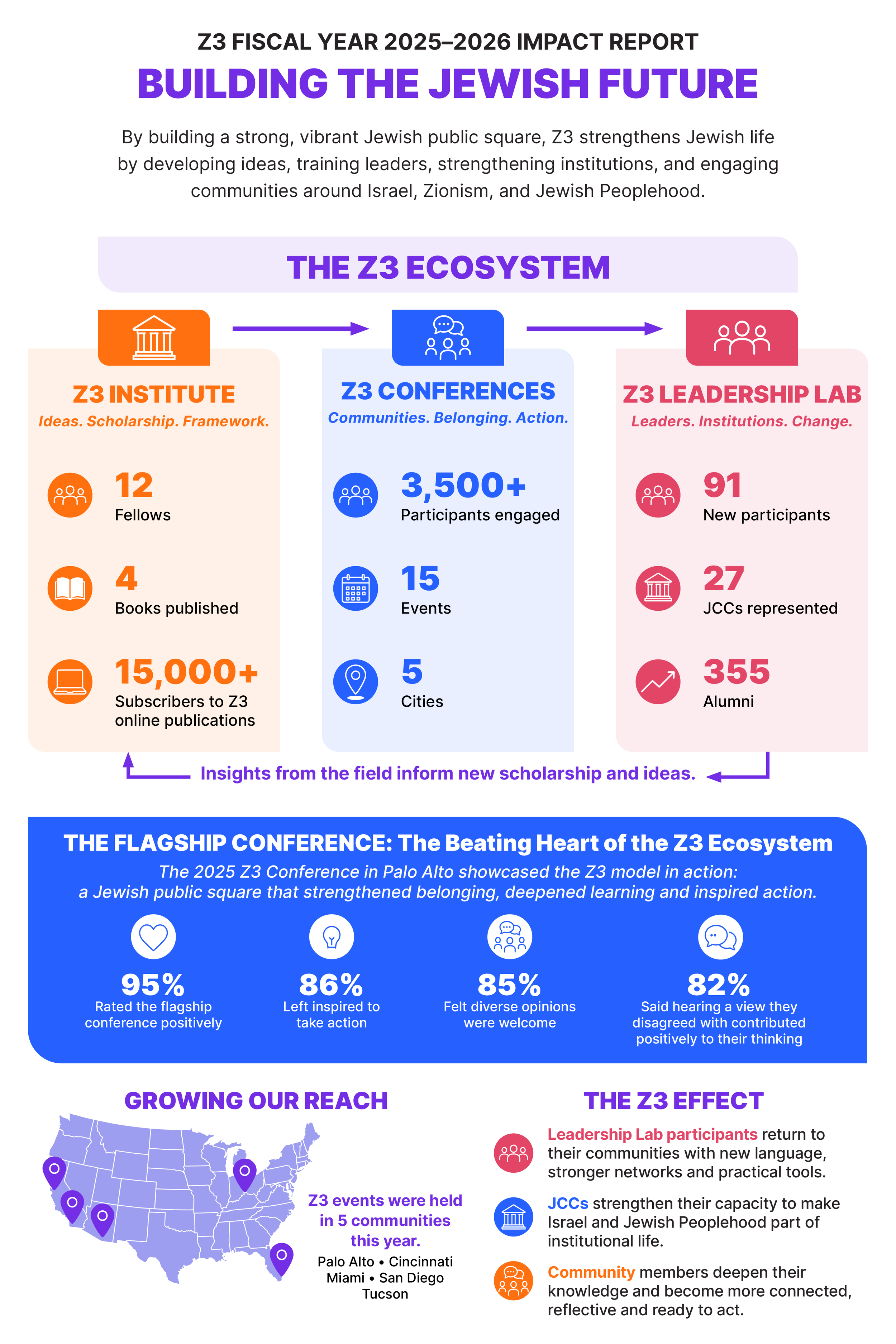
In FY 2025–2026, Z3 engaged more than 3,500 participants across 15 events in five cities. The flagship Z3 Conference in Palo Alto convened approximately 1,500 in-person participants and 650 virtual attendees, including nearly 300 teens. Z3@ partner conferences in Miami, Tucson, San Diego, and Cincinnati drew approximately 700 attendees. The Leadership Lab brought together 91 professionals from 27 JCCs in November 2025, continuing work that has trained approximately 355 professionals from 54 JCCs and 67 Jewish organizations since 2021. The Z3 Institute, launched in November 2024, now includes 12 fellows and has produced seven books, with ten additional titles in development.
These results show that Z3 does more than convene Jews around Israel. It works with JCCs to build the shared language, leadership, and public spaces that can make Israel and Jewish Peoplehood more central to institutional structure.
From Inspiration to Implementation
The Leadership Lab moves Z3 ideas and inspiration toward institutional practice. In November 2025, the Lab brought together 91 professionals from 27 JCCs. Seventy-four completed the post-conference survey, an 81% response rate. Of those respondents, 81% rated the experience Excellent or Exceptional, 76% left highly inspired to act, and 73 of 74 said the Lab contributed to their thinking about Israel and Jewish Peoplehood.
One of the clearest findings was that participants left with plans connected directly to their professional roles. JCC executives began planning strategic conversations about Israel and Peoplehood within their institutions. Early childhood educators reconsidered classroom libraries and how children first encounter Israel and Jewish identity. Camp professionals examined how Israeli staff are welcomed, prepared and woven into camp culture, rather than featured through stand-alone Israel programming.
The Lab also revealed what makes institutional change more likely. Among respondents from JCCs with a strategic plan in place or under development, 67% felt equipped to identify concrete opportunities to integrate Israel and Peoplehood into programs or operations. That dropped to 50% among respondents from JCCs without a plan and to 25% among those unsure of their institution’s direction.
The clearest predictor was not title or seniority. It was whether the institution had already begun the conversation. The difference was less about having a completed plan than about having shared language, aligned colleagues and an awareness of the institution’s direction. This finding is shaping Z3’s next phase of work by placing greater emphasis on JCC delegations and helping teams begin that institutional conversation before arriving at the Lab.
Public Square, Belonging and Action
Z3 conferences are designed around belonging, learning, and action. The goal is to create a setting in which people feel part of a Jewish public square, encounter serious ideas and diverse perspectives, and leave prepared to take greater responsibility in their own communities.
At the flagship Z3 Conference in Palo Alto in 2025, 95% rated the experience positively. The Net Promoter Score was +55 and 86% left inspired to take action. Sixty-nine percent said the conference deepened their thinking about Israel, and 85% felt diverse opinions were welcome. Among those who heard a view they disagreed with, 82% said that disagreement contributed positively to their thinking.
These numbers demonstrate a combination that can be difficult to achieve: belonging without uniformity, pluralism without fragmentation, and readiness to act without ideological conformity. In a Jewish communal landscape often marked by anxiety, polarization, and avoidance, Z3 created a space where people could feel connected, think more deeply, and consider their own responsibility for what comes next.
The same pattern has appeared across recent partner conferences, with appropriate variation by local context and survey sample. Through a shared evaluation framework, Z3 is beginning to build an emerging Z3 Index that tracks belonging, pluralism, reflection, and readiness to act across geographical regions and over time. In Austin, 86% of respondents rated the event Excellent or Exceptional; in Miami, 70%; in Tucson, 63%; and in San Diego, 71%. Support for continued Z3 programming ranged from 86% in San Diego to 97% in Tucson.
These results are not intended to rank communities. They offer an emerging picture of how Jews in different regions experience belonging, difference, and responsibility. Across communities with distinct histories, sizes, and demographics, a consistent pattern is emerging: Z3 strengthens connections, deepens reflection, and increases readiness to engage.
Institutional Adoption and
Intellectual Depth
Z3@ gatherings enable communities to create their own Jewish public squares. Designed and led by JCCs and local partners, each gathering reflects the voice, needs, and character of its community within a shared set of principles. Z3 provides frameworks, guidance, marketing materials, and ongoing support, while partner institutions shape the experience locally.
In FY 2025–2026, Z3@ events took place in Miami, Tucson, San Diego, and Cincinnati, alongside the flagship conference in Palo Alto. Across Z3’s history, partner events have also been held in Los Angeles and Austin. Additional communities, including Chicago, Philadelphia, and Toronto, are in planning or active discussion.
The deepest evidence of institutional change emerges over time. Sustained engagement can help JCCs connect existing commitments, bring Israel and
Peoplehood closer to the center of institutional life, and find locally appropriate expressions of that work.
In Tucson, years of engagement with Z3 have accompanied and accelerated changes in staffing, professional development, board conversations, and the role of the community’s Israel Center. In Austin, Z3 contributed to the thinking behind an interactive Israel wall in the new community atrium, weaving Israel into the building's physical experience. Austin also adopted Beged Kefet, the Hebrew-language program developed by the Oshman Family JCC. In Miami, growing engagement with Israel and Peoplehood contributed to the creation of a new staff position focused on adult Israel and Peoplehood engagement.
These examples do not follow a single formula. That is what institutional ownership looks like. Z3 is not a model to be copied but a framework for institutional leadership. By working alongside JCC teams, Z3 helps communities draw on their own strengths, exercise greater agency, and build capacity to shape Jewish public life on their own terms.
The Z3 Institute gives this work intellectual depth and direction. Since its launch in November 2024, the Institute has brought together 12 fellows and produced seven books, with additional titles in development. Through scholarship, essays, public programs, briefings, and digital publications, the Institute creates ideas and frameworks that help communities think more deeply about Zionism, Jewish Peoplehood, sovereignty, responsibility, and the relationship between Israel and the Diaspora.
Institutional change requires more than individual programs. It requires language and ideas that leaders can return to, teach from, and adapt locally. JCCs create the space in which Jewish public life can flourish. The Institute helps provide the spirit and intellectual discussions that animate that space. The Leadership Lab helps JCC teams weave both into the ongoing life of their institutions.
What We Are Learning
The 2025 results sharpened three core lessons. Belonging creates the conditions for serious engagement. Pluralism must be intentionally designed so that encountering difference can deepen, rather than weaken, a sense of shared responsibility. Inspiration becomes implementation when institutions have shared language, aligned leadership, and an ongoing culture of discussion about Israel and Jewish Peoplehood.
These findings are pushing Z3 toward stronger delegation-based participation, more preparation before gatherings, and more sustained follow-up afterward. Z3 is learning not only which institutions are ready to act, but how it can help more institutions build that readiness.
The results also reinforce the value of connecting local experience with national learning. Insights from partner communities can inform future Leadership Lab content, shape the Institute’s intellectual agenda, and strengthen conference design across the network. As the Z3 Index develops, it can provide a richer picture of how Jewish communities across different regions experience belonging, pluralism, and responsibility.
Looking Ahead
The past year clarified what kind of growth matters most for Z3. The next phase is about disciplined growth: using broad reach to produce deeper and more durable change within institutions and communities.
After several years of significant expansion, the flagship conference has reached a scale where the next gains will come less from adding attendees and more from strengthening what happens before, during, and after the gathering. The measure is no longer simply who attends, but what their participation makes possible afterward: stronger institutional readiness, greater local ownership, and more action back home.
In the year ahead, Z3 will prioritize the parts of the model that turn public inspiration into institutional practice. That means stronger Leadership Lab delegations, more intentional preparation and follow-up, deeper engagement with Z3@ communities, and continued development of the Z3 Institute’s ideas and resources.
Future growth will be judged by what it enables: clearer language, stronger leaders, and JCCs better equipped to make Israel, Zionism, and Jewish Peoplehood part of communal life. The aim is not to replace the meaningful work already happening within Jewish institutions, but to help connect, deepen, and strengthen it.
We are grateful to JCC Association of North America and to the many JCC teams, fellows, participants, funders, and colleagues whose partnership and trust are helping this work grow. Together, we are building the space and spirit necessary for a more resilient, interconnected Jewish future.
Thank you for being a part of this work!
This year has been one of meaningful growth for Z3. Together with our partners, participants, JCCs, fellows, and supporters, we've created spaces for deeper conversations, stronger leadership, and stronger Jewish communities across North America.
Thank you for helping make this work possible. Every conference, conversation, partnership, and act of leadership contributes to a stronger, more connected Jewish future.
We're grateful for all we've accomplished together—and even more excited for what's ahead.